
The Houdini maze scatter workflow now separates inner and outer edge plant outputs, pushes points away from hard wall outlines, and is being checked against the stone maze, grass, and water in Unreal.
The vegetation pass is being driven by the maze itself rather than treated as a flat paint layer. Houdini extracts the outer and inner maze edges, then keeps those zones on separate branches so their plant density and scale can be controlled independently.
Moving away from a hard outline
The first distance-from-edge result kept the points close to the wall outline. That made the scatter read as a hard line and exposed where the push and falloff controls needed more work.
The adjusted VEX pass now uses a distance attribute and falloff ramp to push points away from the edge. Noise, orientation, scale variation, and cleanup are applied before the edge and inner plant outputs are separated for export.
Checking the result in context
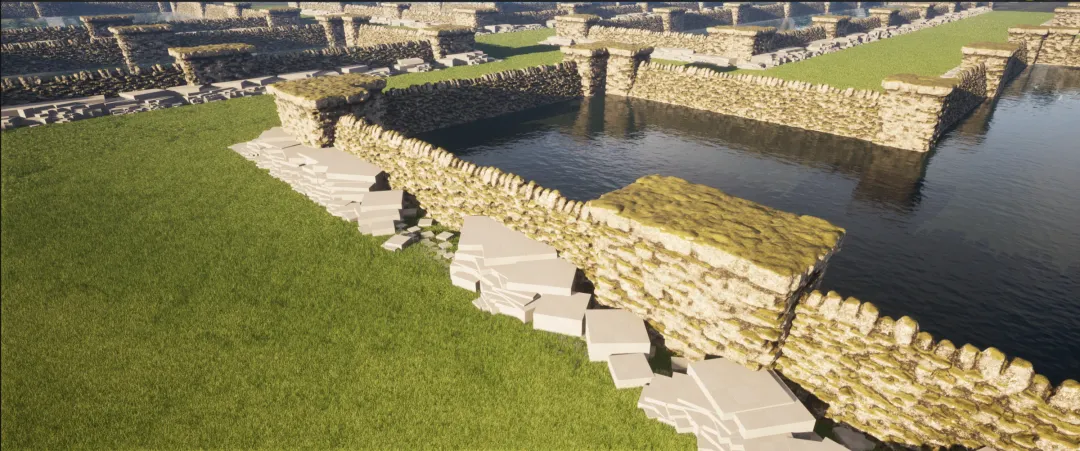
The current Unreal preview brings the stone walls, water, grass, and blockout vegetation together in the same maze scene. That in-engine check is the useful test: it shows whether the procedural controls support the play space without rebuilding the scatter logic by hand in Unreal.
This remains work in progress. The captures document the current production path from edge extraction through to the Unreal preview, rather than a finished vegetation pass.