
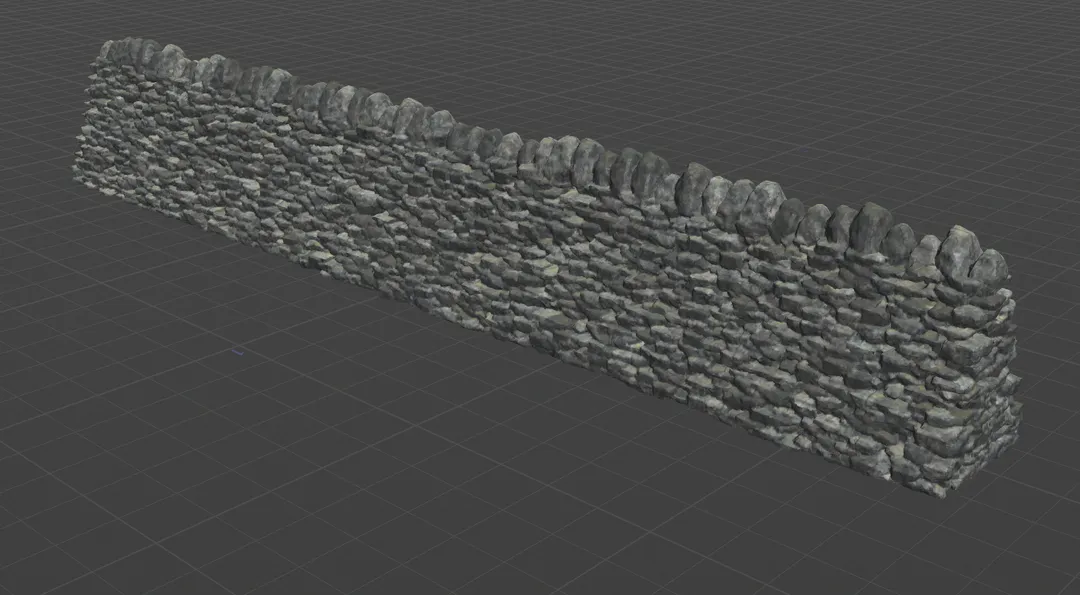
The repeated maze pieces are moving toward shared tiling materials, Houdini masks, edge wear, dirt, moss, and cheap variation.
The current material direction treats the maze as a repeated modular system. Floor tiles, wall tiles, corner pieces, ceiling pieces, hub borders, and door frames should share tiling textures wherever practical instead of receiving a unique material instance and full texture set for every piece.
Shared layers, exported masks
The planned Unreal master blends a base stone layer with dirt and a restrained accent such as moss or a darker cavity treatment. Houdini supplies inexpensive mask data that tells the material where to place edge wear, dirt, breakup, and the accent layer.
For repeated pieces, vertex colours are the first choice: red for edge wear, green for dirt or cavity influence, blue for breakup or block variation, and alpha for the accent mask. A packed mask texture remains an option when a hero asset needs more detail.
Variation without multiplying materials
The same master can support a material instance per map or hub zone. Subtle world-space macro variation and small per-instance colour changes can help break repetition while the repeated meshes continue to share their core mesh and material setup.
The goal is a disciplined material path: shared tiling textures, Houdini-authored controls, readable dry-stone surfaces, and enough variation to support the maze without turning every repeated module into a one-off asset.